
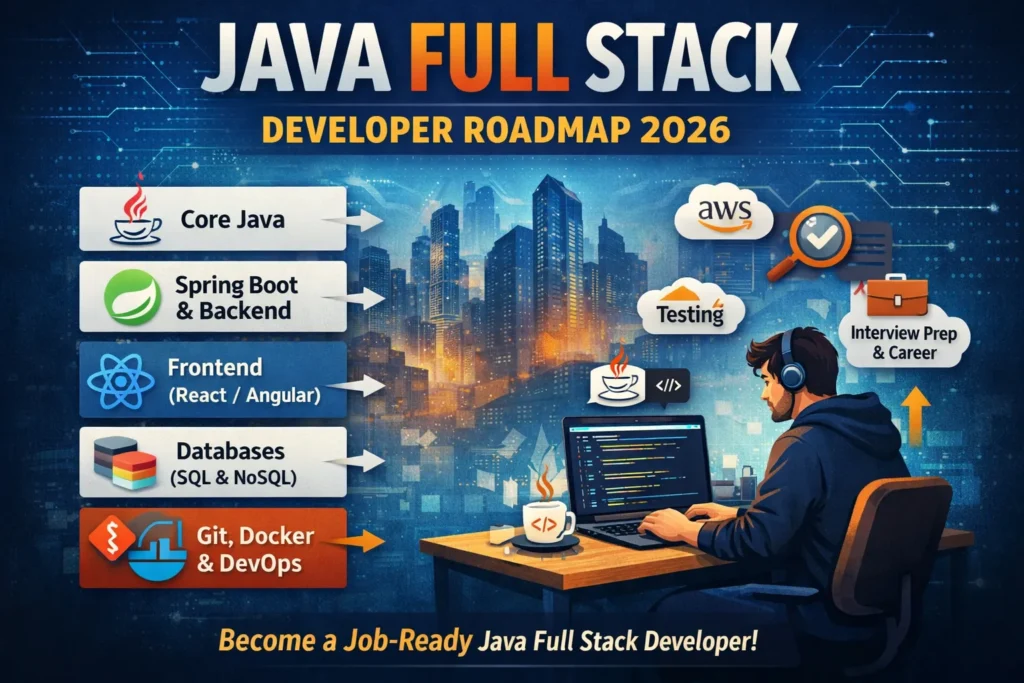
If you’re planning to build a successful career in software development, this Java Full Stack Developer Roadmap will guide you step-by-step. In 2026, companies are actively hiring professionals who can handle both frontend and backend development efficiently. Java remains one of the most powerful and widely used programming languages in enterprise applications, making full stack Java developers highly valuable.
This complete guide covers Points 1 to 8 in detail, ensuring you understand exactly what to learn, in what order, and how to master every essential skill.
Introduction:
Choosing Java full stack development in 2026 is a smart career decision. Java continues to dominate enterprise-level applications, banking systems, fintech platforms, healthcare software, and large-scale web applications. Major companies rely on Java-based frameworks for building secure and scalable systems.
The demand for developers who understand both frontend and backend technologies is growing rapidly. Businesses prefer hiring professionals who can manage entire application development rather than separate frontend and backend teams. That’s where this Java Full Stack Developer Roadmap becomes essential.
Another reason Java remains relevant is its ecosystem. Frameworks like Spring Boot, Hibernate, and microservices architecture have made backend development faster and more efficient. On the frontend side, Java full stack developers integrate technologies like React or Angular to create modern user interfaces.
In 2026, skills like cloud deployment, DevOps, API development, and security integration are becoming mandatory. A structured Java Full Stack Developer Roadmap ensures you stay competitive and job-ready in this evolving tech landscape.
What is a Java Full Stack Developer? Roles & Responsibilities
A Java Full Stack Developer is a professional who works on both frontend (client-side) and backend (server-side) development using Java technologies. They build complete web applications from scratch — from designing user interfaces to managing databases and deploying applications.
Following the Java Full Stack Developer Roadmap, you’ll learn that these developers are responsible for:
- Designing and developing RESTful APIs
- Creating responsive frontend interfaces
- Managing databases
- Writing business logic in Java
- Ensuring application security
- Testing and debugging applications
- Deploying projects on cloud platforms
In backend development, Java full stack developers commonly use Spring Boot to build scalable APIs and services. For frontend development, many use React or Angular.
In simple words, a Java full stack developer acts as a bridge between the client interface and server logic. Companies value them because they reduce dependency between teams and speed up product development cycles.
Prerequisites: Skills You Need Before Starting the Java Full Stack Developer Roadmap
Before diving into the Java Full Stack Developer Roadmap, you need a few foundational skills. These basics will make your learning journey smoother and faster.
First, you should understand basic programming logic. Concepts like variables, loops, conditional statements, and functions are essential. If you’re completely new to coding, start with beginner-level Java tutorials.
Second, basic knowledge of HTML and CSS helps you understand how web pages are structured and styled. Even if you plan to focus more on backend development, frontend basics are necessary for full stack development.
Third, logical thinking and problem-solving skills are critical. Platforms like coding practice websites help strengthen your understanding of algorithms and data structures.
Finally, familiarity with databases and how data is stored will help when you move to backend development. Understanding how applications interact with databases is a core part of this Java Full Stack Developer Roadmap.
If you master these prerequisites, your transition into advanced Java concepts becomes much easier.
Step 1: Master Core Java Fundamentals
The foundation of the Java Full Stack Developer Roadmap begins with mastering Core Java. Without strong fundamentals, learning frameworks becomes confusing and overwhelming.
You must thoroughly understand:
- Object-Oriented Programming (OOP)
- Classes and Objects
- Inheritance and Polymorphism
- Encapsulation and Abstraction
- Data Types and Variables
- Exception Handling
- Multithreading
- Collections Framework
Core Java teaches you how applications are structured and how logic is written. Since backend development heavily relies on Java, weak fundamentals can limit your growth.
Practice writing small programs daily. Create simple console-based projects like a student management system or banking application simulation. This improves logical thinking and prepares you for advanced backend concepts.
The stronger your core Java knowledge, the easier the rest of the Java Full Stack Developer Roadmap becomes.
Step 2: Learn Advanced Java & Backend Development
Once your fundamentals are strong, the next step in the Java Full Stack Developer Roadmap is backend development. This is where real application development begins.
Start by learning:
- JDBC (Java Database Connectivity)
- Servlets and JSP
- RESTful API development
- JSON data handling
Understanding how Java connects to databases is essential. JDBC allows applications to communicate with databases like MySQL or PostgreSQL.
Next, learn how to build REST APIs. Modern applications communicate through APIs, making this skill extremely important. API development teaches you how frontend and backend systems interact.
You’ll also learn about HTTP methods like GET, POST, PUT, and DELETE. These are core to backend services.
At this stage, build small backend projects like a CRUD (Create, Read, Update, Delete) application. This strengthens your understanding and prepares you for Spring framework learning.
Backend development is the backbone of the Java Full Stack Developer Roadmap, so spend enough time mastering it.
Step 3: Master Spring & Spring Boot Framework
No Java Full Stack Developer Roadmap is complete without mastering Spring. Spring simplifies backend development and is widely used in enterprise applications.
Start with Spring Core concepts like Dependency Injection and Inversion of Control. These concepts make applications modular and easier to maintain.
Then move to Spring MVC, which helps build web applications efficiently. After that, learn Spring Boot, which simplifies configuration and accelerates development.
Spring Boot allows you to build production-ready applications quickly. It provides built-in server support and auto-configuration features.
You should also learn:
- Spring Security
- Hibernate & JPA
- Microservices architecture
Spring Boot combined with microservices is extremely popular in 2026. Companies prefer scalable systems, and Spring Boot makes this possible.
Mastering Spring technologies makes you industry-ready and significantly increases your job opportunities.
Step 4: Frontend Development for Java Full Stack
Frontend development is equally important in the Java Full Stack Developer Roadmap. A strong backend without a user-friendly interface is incomplete.
Start with:
- HTML5
- CSS3
- JavaScript (ES6+)
HTML structures web pages, CSS styles them, and JavaScript adds interactivity.
After mastering basics, move to modern frontend frameworks like React or Angular.
React is popular for building fast, dynamic user interfaces, while Angular provides a complete framework for large-scale applications.
Learn how frontend applications connect with backend APIs using fetch or Axios. Understand concepts like state management, routing, and responsive design.
Build projects like:
- Login & Registration System
- E-commerce UI
- Dashboard with API integration
Frontend development makes you a complete full stack developer and completes a major portion of the Java Full Stack Developer Roadmap.
Step 5: Database Management Systems
Databases are critical in the Java Full Stack Developer Roadmap. Every application stores and retrieves data, so database knowledge is mandatory.
Start with relational databases like:
- MySQL
- PostgreSQL
Learn SQL queries such as SELECT, INSERT, UPDATE, DELETE, JOIN, GROUP BY, and indexing.
Then move to NoSQL databases like MongoDB, which are useful for handling large-scale and flexible data structures.
Also, understand ORM tools like Hibernate and JPA. These tools help map Java objects to database tables, reducing manual SQL writing.
Focus on:
- Database normalization
- Relationships (One-to-One, One-to-Many, Many-to-Many)
- Transactions and indexing
Build projects where your backend interacts with a database. This strengthens real-world development skills.
Database management completes the technical foundation of your Java Full Stack Developer Roadmap and prepares you for advanced DevOps and deployment stages.
Step 6: Version Control & DevOps Tools
In 2026, knowing only coding is not enough. A complete Java Full Stack Developer Roadmap must include version control and DevOps fundamentals. Companies expect developers to manage code efficiently and collaborate with teams using industry-standard tools.
The first tool you must master is Git. Git helps track code changes, manage branches, and collaborate with teams. After Git, learn GitHub, which allows you to host repositories and showcase your projects.
Next, understand build tools like Maven and Gradle. These tools manage dependencies and automate project builds.
You should also learn containerization using Docker. Docker packages your application with all dependencies, making deployment easier.
Finally, understand CI/CD (Continuous Integration & Continuous Deployment) concepts. DevOps knowledge increases your job value significantly and makes you a modern full stack developer.
Step 7: Build Real-World Java Full Stack Projects
Projects are the backbone of the Java Full Stack Developer Roadmap. Without hands-on projects, theoretical knowledge is incomplete. Recruiters prioritize practical experience over certificates.
Start with small projects like:
- CRUD Application using Spring Boot
- Authentication & Authorization System
- Blog Management System
Then move to advanced projects like:
- E-commerce Web Application
- Online Banking System
- Job Portal Application
- Microservices-based Project
Build projects using Spring Boot for backend and React or Angular for frontend.
Make sure your projects include:
- Authentication (JWT or Spring Security)
- REST APIs
- Database integration
- Cloud deployment
Host your code on GitHub and deploy live demos. A strong portfolio can sometimes replace years of experience. Projects prove you can apply the Java Full Stack Developer Roadmap in real-world scenarios.
Step 8: Learn Testing & Debugging
Testing is a critical part of the Java Full Stack Developer Roadmap. Writing code is only half the job; ensuring it works correctly is equally important.
For backend testing, learn JUnit. It helps test Java methods and business logic. You should also learn Mockito for mocking objects in unit tests.
Understand:
- Unit Testing
- Integration Testing
- API Testing
- Exception Testing
For API testing, tools like Postman are useful. On the frontend side, learn basic testing practices for UI components.
Debugging skills are also crucial. Use IDE debugging tools to track issues efficiently. Learn how to read logs and fix runtime errors.
Companies prefer developers who write testable and maintainable code. Strong testing skills make you a professional developer rather than just a coder.
Step 9: Deployment & Cloud Fundamentals
Modern applications are deployed on cloud platforms. Therefore, cloud knowledge is essential in the Java Full Stack Developer Roadmap.
Start by understanding hosting basics and application servers. Then move to cloud platforms like Amazon Web Services and Microsoft Azure.
Learn:
- Deploying Spring Boot applications
- Cloud storage basics
- Server configuration
- Environment variables
- Basic networking
You should also understand container deployment using Docker and cloud CI/CD pipelines.
In 2026, companies prefer developers who can develop and deploy applications independently. Cloud knowledge makes you more versatile and increases your salary potential.
Deployment skills complete the production-ready phase of the Java Full Stack Developer Roadmap.
Step 10: Prepare for Java Full Stack Developer Interviews
Interview preparation is a strategic step in the Java Full Stack Developer Roadmap. Technical knowledge alone isn’t enough; you must know how to present it effectively.
Prepare the following topics:
- Core Java & OOP concepts
- Data Structures & Algorithms
- Spring Boot & REST APIs
- SQL Queries & Database Design
- Frontend fundamentals (React/Angular)
- System Design Basics
Practice coding problems daily. Revise common interview questions related to multithreading, collections, and API development.
Also prepare to explain your projects clearly. Interviewers often ask about:
- Architecture decisions
- Challenges faced
- Security implementation
- Performance optimization
Mock interviews and resume optimization play a key role. Tailor your resume according to the job description.
Interview preparation transforms your learning into job opportunities.
Certifications to Boost Your Java Full Stack Career in 2026
Certifications are not mandatory but can strengthen your Java Full Stack Developer Roadmap. They validate your skills and add credibility to your resume.
Popular certifications include:
- Oracle Java Certification
- AWS Cloud Practitioner
- Spring Professional Certification
Certifications help beginners stand out in competitive markets. However, remember that skills and projects matter more than certificates.
If you’re a fresher, combining certifications with real-world projects creates a powerful profile. For experienced developers, cloud certifications significantly boost salary prospects.
Choose certifications that align with your career goals rather than collecting random credentials.
Java Full Stack Developer Salary & Career Opportunities in 2026
The final stage of the Java Full Stack Developer Roadmap focuses on career growth and salary expectations.
In 2026, Java full stack developers are in high demand across industries like:
- Fintech
- Healthcare
- E-commerce
- SaaS companies
- Enterprise software firms
In India, entry-level salaries typically range from ₹4–8 LPA, while experienced developers can earn ₹12–25+ LPA depending on skills and company size. Globally, salaries are even higher.
Career growth roles include:
- Senior Full Stack Developer
- Backend Architect
- Technical Lead
- DevOps Engineer
- Solution Architect
Continuous learning is key. Technologies evolve rapidly, so updating your skills regularly ensures long-term success.
Completing this Java Full Stack Developer Roadmap makes you industry-ready and opens doors to global opportunities.
Conclusion:
Becoming a successful developer in 2026 requires more than just learning a programming language. This complete Java Full Stack Developer Roadmap gives you a structured path — from mastering Core Java fundamentals to deploying cloud-ready applications.
You started with understanding Java basics and OOP concepts. Then you progressed into backend development using frameworks like Spring Boot, built responsive frontends with modern technologies, integrated databases, and learned DevOps tools like Git and Docker. Finally, you explored testing, cloud deployment, interview preparation, certifications, and career growth strategies.
The key to success is consistency. Focus on building strong fundamentals, practice daily, and create real-world projects. Avoid rushing through topics just to complete the roadmap. Instead, aim for deep understanding and hands-on experience.
Remember, companies hire problem solvers — not just certificate holders. If you follow this Java Full Stack Developer Roadmap step-by-step, build projects, and continuously upgrade your skills, you can confidently position yourself for high-paying roles in India and globally.
Your journey may take 6–12 months depending on your dedication, but with discipline and practical learning, becoming a job-ready Java full stack developer in 2026 is absolutely achievable.
For deeper insights, check this guide.👉 Java Full Stack Developer Roadmap